
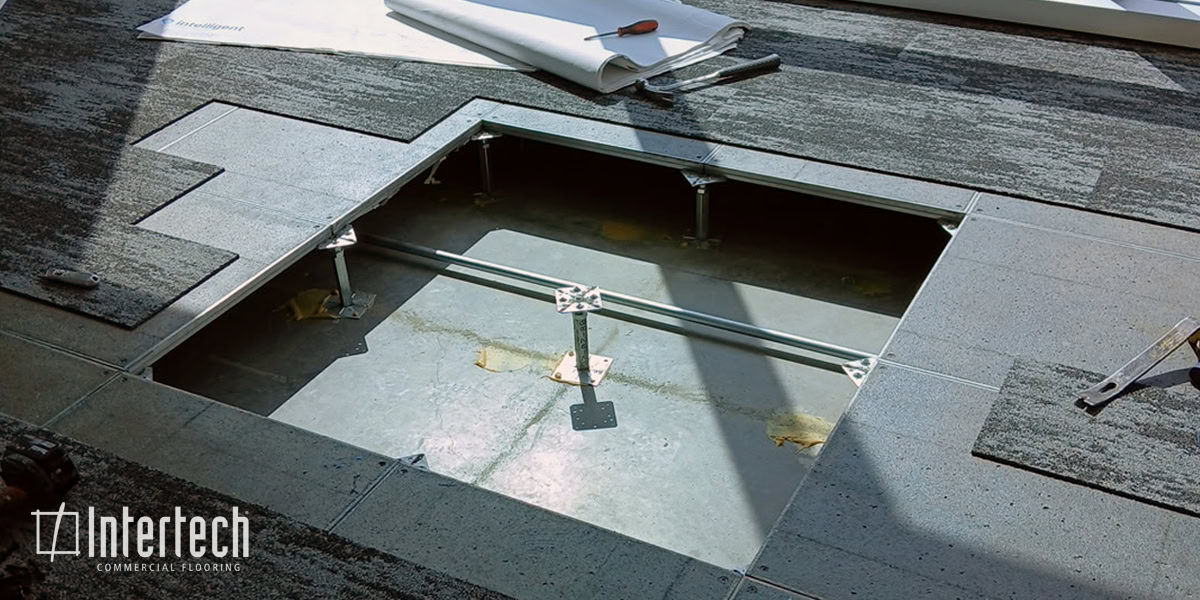
When & How to Reinforce Raised Access Flooring
You’ve invested in a state-of-the-art raised access flooring system for your data center or server room. Everything runs smoothly for years. Then your IT team announces they’re upgrading to newer, more powerful servers. There’s just one problem: the new equipment weighs significantly more than what your floor was originally designed to handle.
This scenario plays out more often than you might think. As technology advances, server equipment becomes more powerful and often heavier. What worked perfectly five or ten years ago may no longer be adequate for today’s infrastructure needs.
At Intertech, we’ve seen our raised access flooring work increase significantly in recent years, mainly due to new data centers and companies buying newer, heavier servers. Understanding when and how to reinforce raised access flooring can help prevent costly equipment failures, maintain your warranty and keep your operations running smoothly.
Understanding Load Capacity: It’s Not Just About Total Weight
Before diving into reinforcement options, it’s important to understand how raised access flooring handles weight. Many facility managers make the mistake of focusing only on the total equipment weight, but that doesn’t tell the whole story.
The Critical Concept: Point Load
What matters most is something called point load – the weight concentrated at any single point touching the floor. This is where many people get confused about whether their floor can handle new equipment.
Here’s a practical example: You might have a piece of equipment that weighs 2,000 pounds total. If it has eight legs supporting it, each leg only carries about 250 pounds. Your standard 1,250-pound capacity panel handles that easily.
However, if you have a 10,000-pound machine with only four contact points, each point bears 2,500 pounds. That significantly exceeds the capacity of a standard panel, and that’s when reinforcement becomes necessary.
The manufacturer’s engineers perform calculations based on the point load to determine the type of pedestals and any required bracing. It’s not just about the total weight – it’s about how that weight is distributed across the floor.
Understanding Rolling Loads
There’s another type of load that often gets overlooked: rolling loads. If your equipment sits on casters instead of fixed leveling feet, you’re dealing with a different type of stress on your floor system.
Rolling loads are typically more severe than static loads because they create additional forces as the equipment moves across panels. A panel with a 1,250-pound concentrated load rating may support only 1,000-1,125 pounds under rolling load, depending on how often the equipment is moved.
This is particularly important in data centers where server racks on casters are regularly repositioned for maintenance or upgrades.
Common Reasons for Raised Access Flooring Reinforcement
Reinforcement needs typically fall into two main categories: stability and strength.
Stability Needs: Controlling Sway in Tall Installations
Stability becomes critical with very tall pedestals. The taller the pedestal, the more prone it is to lateral movement or sway. Think about it like a long tube standing upright – it’s much easier to bend in the middle than a short one.
Taller installations – typically 36 inches or higher, which are often required for underfloor air distribution systems – need additional bracing to prevent lateral movement. Without proper stabilization, tall pedestals can develop sway, compromising the integrity of the entire floor system and creating an unsafe working environment.
Strength Needs: Supporting Heavy Equipment Loads
Strength reinforcement is required when you’re handling heavy equipment loads that exceed your current panel capacity. This is increasingly common as server density continues to climb in modern data centers.
Raised access flooring reinforcement is most common in:
- Data centers with high-density server racks
- Chemical plants with heavy processing equipment
- Electrical plants with substantial machinery
- Corporate server rooms undergoing equipment upgrades
- Any facility adding heavier infrastructure to existing raised floors
While most facilities don’t have more than 4,000 or 5,000 pounds concentrated on a single panel, when you do encounter these heavy loads, proper reinforcement planning becomes essential.
Standard Panel Capacities: Know Your Starting Point
Understanding what you’re working with is the first step in determining if reinforcement is needed. The standard raised access floor panel is 1.125 inches thick with a 1,250-pound concentrated load capacity. That rating refers to the maximum weight the panel can support at a single point without exceeding acceptable deflection limits.
Each panel is 2 feet by 2 feet (24″ x 24″), creating a grid system supported by pedestals at each corner. The panels themselves look identical regardless of thickness – you can’t tell the difference just by looking at them. You can only tell when you pick one up, as the thicker panels weigh about 10 more pounds because they’re filled with concrete.
Reinforcement Options: From Simple to Comprehensive
The good news is that there are several ways to reinforce raised access flooring, and the solution can be tailored to your specific needs and budget.
Option 1: Upgrade the Panel Thickness
The most straightforward approach is moving from a standard 1.125-inch panel to a thicker 1.5-inch panel. This upgrade increases your concentrated load capacity per panel from 1,250 pounds to 2,000 pounds.
While the panels appear identical from above, the thicker version offers significantly greater strength. This option works well when you’re dealing with moderately heavier equipment across your entire floor space.
Option 2: Add Stringers for Distributed Support
Stringers are steel supports that connect pedestals together, creating a stronger framework beneath the panels. Think of them like the floor joists in traditional construction – they distribute the load more effectively across multiple support points.
A stringer runs from pedestal to pedestal, essentially creating a frame system under the panels. This reduces stress on individual panels and increases the system’s overall carrying capacity.
Panel thickness determines the base load capacity. A standard 1.125-inch panel supports 1,250 pounds, while a thicker 1.5-inch panel supports 2,000 pounds. Adding stringers increases these capacities further. When you add a stringer to a standard panel, the capacity increases to 1,500 pounds. For the thicker 1.5-inch panel, adding a stringer boosts the capacity to 2,500 pounds. The stringer connects the pedestals, providing additional support that makes all the difference in load distribution and overall system strength.
Option 3: Add Support Pedestals
Sometimes the quickest and most cost-effective solution is adding an extra pedestal in the center of a panel. This approach is particularly useful for retrofitting existing floors where you need to accommodate new, heavier equipment without replacing entire sections.
“The quickest solution is to put another pedestal identical to what’s already there in the middle of the panel. That increases load capacity significantly because we’re supporting the weakest point.” – Billy Chrzan, Project Manager, Intertech Flooring
This method can increase your load capacity by up to 5x by eliminating the unsupported center span of the panel.
Important Considerations for Center Pedestals
There’s one critical thing to understand about this method: the center pedestal isn’t attached to anything. It simply sits there providing support from below.
If you install that panel and do any work underneath, the center pedestal becomes unusable and will need to be repositioned during reinstall. It’s not attached, so if you bump it even a sixteenth of an inch when the panel is up, your floor will rock when you put it back.
This is why proper documentation and training for your maintenance staff is so important when this reinforcement method is used.
Option 4: Lateral Bracing for Tall or Heavily Loaded Installations
For very tall raised access floors or extremely heavy concentrated loads, lateral bracing may be necessary. This involves adding arms or braces that connect pedestals to each other or anchor them directly to the concrete substrate at 45-degree angles. Engineers may perform pull-over tests, formally known as pedestal overturning moment tests under CISCA standards, to determine the exact bracing requirements based on the force needed to move glued-down pedestals.
These braces create a rigid grid system that prevents sway and eliminates structural flex. The bracing essentially turns your individual pedestals into an interconnected framework that’s much more stable than standalone supports.
Think about it: you’ve got a long inch-and-a-half square tube, say six or eight feet long. It’s easy to bend that right in the middle. The bracket, set at a 45-degree angle, connects to the next pedestal or anchors to the concrete base. This creates a grid pattern connected to a grid pattern, eliminating sway entirely.
While this is the most robust solution, it’s needed less frequently than other options. Most situations don’t require this level of reinforcement because the load is usually distributed across multiple panels. However, when tall pedestals or extreme loads are involved, lateral bracing becomes essential for safety and stability.
Maintaining Your Warranty: Critical Rules for Accessing Under the Floor
If you need to access the area beneath your raised access floor for maintenance, cable management or upgrades, there’s an important rule that many facility managers don’t know: never remove more than a single row of panels at a time.
Here’s why this matters: If you take up four panels that are side by side in a square pattern, any center pedestals are now floating and not attached to anything.
If you just bump a center pedestal and change it even a sixteenth of an inch, your floor is going to rock when you put the panels back. This creates safety hazards and operational issues.
The Correct Way to Remove Panels
Always remove panels in a single straight line. This keeps the outer edges attached to adjacent panels that remain in place, maintaining the pedestal positions and ensuring proper alignment during reinstallation.
If your team needs to remove a larger area – say they need 48 inches of working space instead of just 24 inches – you’ll need to call Intertech Flooring or your raised access flooring contractor to handle the reinstallation properly.
Often, facility teams need more working space than a single row provides. In those cases, professional reinstallation is necessary to ensure the floor is properly aligned and the warranty remains intact.
This isn’t just about aesthetics or minor inconveniences. Improperly reinstalled panels can create uneven surfaces, rocking, and even safety hazards. More importantly, it can void the warranty on your entire floor system.
Proactive vs. Reactive: Planning Ahead Saves Money and Downtime
The best time to think about raised access flooring reinforcement is before you need it. Taking a proactive approach offers significant advantages over waiting until you have a problem.
The Proactive Approach
If you’re planning equipment upgrades, work with your IT team and flooring contractor early in the process. Share the specifications and weights of new infrastructure before it arrives. Your contractor can work with manufacturers’ engineers to:
- Calculate exact point loads based on equipment specifications
- Determine if your current system can handle the load
- Identify what reinforcement will be necessary
- Plan installation during scheduled downtime
- Order materials in advance to avoid delays
This proactive approach prevents rushed solutions, eliminates emergency costs and avoids potential downtime. You can schedule reinforcement work during planned maintenance windows when it’s least disruptive to operations.
The Reactive Approach: Warning Signs
Sometimes reinforcement needs aren’t anticipated. Your floor may have been adequate when installed, but changes in use or deterioration over time can create problems. Watch for these warning signs that your floor system may be overloaded:
- Panels that feel bouncy or springy underfoot
- Visible flex or movement when equipment is in place
- Creaking or popping sounds when people walk across the floor
- Panels that have become unlevel or show gaps at the corners
- Cracks in panel surfaces or edge trim damage
If you notice any of these signs, don’t wait. Have your floor system assessed immediately. What starts as a minor deflection can progress to panel failure, which could damage expensive equipment or create safety hazards.
Working with the Right Partner: Expertise Matters
Raised access flooring reinforcement isn’t a DIY project. It requires specialized knowledge, precise calculations and expertise in structural engineering principles applied to modular floor systems.
Intertech has worked with raised access flooring systems for more than 30 years, partnering directly with manufacturers’ engineers to calculate loads, determine the right reinforcement approach and ensure everything meets specifications.
Working with the Right Partner
When evaluating contractors, look for extensive experience specifically with reinforcement projects, not just new installations. The right partner should be able to assess your current system’s capacity, calculate point loads and rolling loads for your equipment, and recommend solutions that fit both your needs and your budget. Industry experience matters too. Data center flooring has different requirements than chemical plant flooring, and a contractor familiar with your environment will understand the challenges you face.
Direct relationships with manufacturers make a difference. A contractor who can access engineering support for complex load calculations will deliver more reliable results than one working from general guidelines. Ask potential contractors which manufacturers they partner with, how they handle warranty documentation, and whether they can provide references from similar facilities.
Intertech is the exclusive Global IFS dealer from Waco to the southernmost tip of Texas. That partnership means we work directly with Global’s engineering team to calculate loads, determine the right reinforcement approach, and ensure everything meets specifications.
Real-World Applications: Where Reinforcement Is Most Common
Understanding where reinforcement is typically needed can help you anticipate your own facility’s requirements.
Data Centers & Server Rooms
This is by far the most common application. As server technology advances, equipment becomes more powerful and more densely packed. A server rack that weighed 1,500 pounds five years ago might now weigh 3,000 pounds or more with current technology.
Data centers also frequently reconfigure equipment layouts, which means rolling loads are a constant consideration. Reinforcement ensures the floor can support both static loads and dynamic forces from moving equipment.
Chemical & Manufacturing Plants
These facilities often have heavy processing equipment, storage vessels and machinery that exceed standard floor capacities. The equipment is typically stationary, so the focus is on concentrated load capacity rather than rolling loads.
Electrical Substations & Utility Plants
Electrical equipment – transformers, switchgear, battery banks – can be extremely heavy. These facilities often require reinforcement during initial installation and may also require upgrades as the electrical infrastructure is expanded or modernized.
Corporate Server Rooms
While not as large as dedicated data centers, corporate server rooms face similar challenges as companies upgrade their IT infrastructure. These spaces were often built decades ago with lighter equipment in mind, and reinforcement is frequently needed when major technology refreshes occur.
The Cost of Waiting
Some facility managers hesitate to invest in reinforcement, hoping their existing floor will be “good enough.” This approach can lead to consequences far more expensive than the reinforcement would have been.
Operating beyond your floor’s rated capacity puts equipment, people, and budgets at risk. A failing panel can cause servers to tip or drop, resulting in damage that may not be immediately apparent but could lead to data loss or hardware failure. Unstable floors create trip hazards for staff. Exceeding load ratings can void both your floor system and equipment warranties.
Emergency repairs and reactive reinforcement work also cost significantly more than planned installations, and you’ll face unplanned downtime and operational disruption. In some jurisdictions, overloaded floor systems can trigger code violations and associated penalties.
The cost of proper reinforcement is almost always less than the cost of dealing with floor failure and its consequences.
Industry Standards & Testing
Raised access flooring systems are subject to industry standards that ensure safety and performance. The Ceilings & Interior Systems Construction Association (CISCA) publishes widely recognized standards for access floor testing and performance.
These standards cover:
- Concentrated load testing (weight at a single point)
- Uniform load testing (weight distributed across the entire panel)
- Rolling load testing (weight on casters moved across panels)
- Impact load testing (resistance to dropped objects)
- Fire resistance ratings
- Electrical properties for static dissipation
When reinforcement is designed and installed, it should meet or exceed these industry standards. Your contractor should be able to provide documentation showing that reinforced systems meet applicable CISCA standards and building codes.
Documentation: An Often-Overlooked Critical Step
When reinforcement work is completed, proper documentation is essential. This should include:
- Original floor specifications and load ratings
- Calculations showing new load capacities after reinforcement
- As-built drawings showing the location of all reinforcement components
- Photos of installation
- Updated warranty information
- Maintenance guidelines specific to the reinforced areas
This documentation serves several important purposes:
- It provides critical information for future equipment planning
- It helps new facility managers understand the system
- It’s necessary for warranty claims
- It may be required for insurance or regulatory purposes
- It guides maintenance staff in proper panel removal procedures
Keep this documentation in multiple locations – both physical and digital copies – and ensure it’s updated whenever changes are made to the floor system.
Making the Right Decision for Your Facility
Raised access flooring systems are engineered to handle significant loads, but they’re not infinite in capacity. As your infrastructure needs evolve, your flooring system may need to evolve with it.
Whether you’re installing new heavy equipment, planning a data center expansion, or noticing signs that your current floor is failing, reinforcement options can strengthen your system. From thicker panels and stringers to additional pedestals and lateral bracing, the right solution depends on your specific load requirements, installation conditions and budget.
Working with experienced professionals who can accurately assess your needs, calculate the engineering requirements and implement reinforcement solutions will keep your operations running safely and efficiently. Taking a proactive approach – planning ahead for equipment upgrades and addressing potential issues before they become problems – will save you money, prevent downtime and extend the life of your floor system.
Don’t wait until your panels fail or equipment is at risk. If you’re considering infrastructure changes or have any concerns about your current floor’s capacity, schedule an assessment now. A small investment in reinforcement today can prevent costly failures tomorrow.
Need to assess your raised access flooring capacity or discuss reinforcement options?
Intertech’s team has decades of experience with complex raised access flooring projects across data centers, industrial facilities and corporate environments. Contact us to discuss your specific needs and ensure your floor system can handle whatever equipment comes next.
Recent Posts
Need Samples?
Order from multiple vendors, all at once!
You’ve Got Better Things To Do...
Enjoy our one-stop approach to easy sample orders.